Property Registration Process for Whitefield Apartments 2026

Registering your Whitefield apartment is the legal act that transfers ownership from the builder (or seller) to you. Until a sale deed is executed and registered before the Sub-Registrar under the Registration Act 1908, the property is not legally yours in the eyes of the law, regardless of how much you have paid. Many buyers understand the stamp duty and registration fee costs but are less familiar with the specific steps, the documents to carry on registration day, the TDS obligation on purchases above Rs 50 lakh, and what to do after the registration is complete. This guide walks through each stage in the order it occurs, for both K-RERA-registered new-launch purchases and resale transactions.
What Property Registration Means
Registration is the formal recording of the sale deed at the Sub-Registrar of Assurances office. The Indian Registration Act 1908 makes registration compulsory for all immovable property transactions above Rs 100 (a threshold that effectively covers every apartment purchase). An unregistered sale deed is inadmissible as evidence in a court of law and cannot establish legal title. Registration also creates a public record of the transaction; anyone can verify the ownership chain through an Encumbrance Certificate after registration.
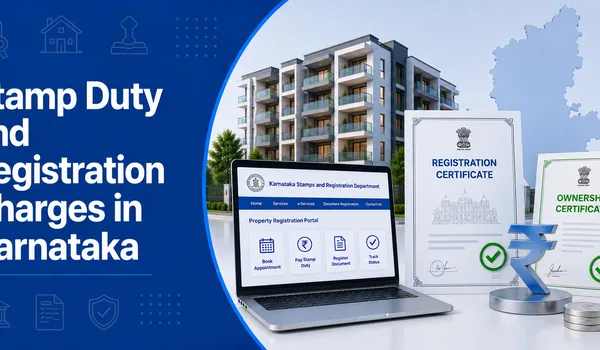
Stamp duty is paid on the value of the transaction at rates set by the state government; in Karnataka, stamp duty is charged at approximately 5% for apartments above Rs 45 lakh plus applicable cess and surcharge, and registration fee is typically 1%. The stamp duty and registration charges guide covers the applicable slab rates, Kaveri Online payment process and worked examples in detail.
Bottom line: until your sale deed is registered before the Sub-Registrar, you do not hold legal title to the property; registration is not optional.
When Registration Happens for a New-Launch Apartment
For a new-launch under-construction apartment, the sale deed registration typically occurs close to possession, once the builder has obtained the Occupancy Certificate (OC) or Completion Certificate (CC) and all pending payments have been cleared. In some projects, especially for higher-floor units in multi-tower developments, registration may happen at different phases as towers receive their individual OC. In a resale transaction, registration can happen at any point agreed by buyer and seller, typically within a few weeks of signing the sale agreement.
The occupancy certificate guide explains what the OC certifies, the difference between OC and CC, and why home loan banks link final disbursement to OC availability.
Bottom line: ask the builder for the expected OC date and registration window at the time of booking; this sets the practical timeline for when you will need to arrange the stamp duty payment and registration-day documents.
Step-by-Step Registration Process
| Step | What happens | Who does it |
|---|---|---|
| 1. Clear all pending payments | Pay the final instalment and any other outstanding charges; obtain a no-dues certificate and possession letter from the builder | Buyer; builder issues the no-dues certificate |
| 2. Draft the sale deed | A property lawyer (or the builder's lawyer for new launches) drafts the sale deed with the agreed consideration, schedule of property, title history and representations | Property lawyer |
| 3. Pay stamp duty via Kaveri Online | Calculate stamp duty on the higher of sale consideration or guidance value; pay on Kaveri Online Services (IGR Karnataka portal); print the e-stamp certificate | Buyer; stamp duty is the buyer's obligation |
| 4. Deduct and pay TDS (if applicable) | If sale consideration exceeds Rs 50 lakh, deduct 1% TDS from the payment to the seller and deposit it using Form 26QB on the Income Tax e-filing portal; generate Form 16B for the seller | Buyer |
| 5. Book a Sub-Registrar appointment | Book a slot at the relevant Sub-Registrar office via Kaveri Online or in person; bring all parties and witnesses on the scheduled date | Either party; usually co-ordinated by builder or lawyer |
| 6. Appear before the Sub-Registrar | Both buyer and seller (or authorised representative) appear with identity documents and witnesses; the Sub-Registrar verifies identity biometrically and reads the deed | Buyer, seller and two witnesses |
| 7. Execute the sale deed | All parties sign the sale deed; the Sub-Registrar stamps and registers it; you receive the registered copy of the sale deed (or it is available for collection within a few days) | Sub-Registrar office |
| 8. Obtain registered copy and EC | Collect the registered sale deed; apply for an updated Encumbrance Certificate to confirm the transaction is on public record | Buyer |
Bottom line: registration day requires advance preparation, specifically the e-stamp, TDS payment and the complete document set; arriving without any one of these can result in a failed appointment.
Documents to Carry on Registration Day
| Document | Applicable to |
|---|---|
| PAN card (original + copy) | Buyer and seller |
| Aadhaar card (original + copy) | Buyer and seller |
| Passport-size photographs (minimum 3) | Buyer and seller |
| Original agreement for sale | Both parties |
| Allotment letter and all demand letter payment receipts | Buyer (new launch) |
| No-dues certificate from builder | Buyer (new launch) |
| Sale deed (original drafted and printed on stamp paper) | Both parties |
| E-stamp certificate from Kaveri Online | Buyer |
| Form 26QB acknowledgement (TDS challan) and Form 16B | Buyer (if consideration > Rs 50 lakh) |
| Home loan sanction letter or bank NOC (if loan was taken) | Buyer |
| Two witnesses with identity proof | Both parties |
Your property lawyer should provide a project-specific checklist a week before registration day. For resale transactions, additional documents such as the seller's registered title deed, previous EC, and property tax receipts are also required. The legal due diligence guide covers these resale documents and how to verify the title chain before entering a resale transaction.
Bottom line: prepare the document set at least a week before registration day; missing documents cannot be supplied on the spot and the appointment will need to be rebooked.
TDS on Property Purchase: What Buyers Must Know
Under Section 194-IA of the Income Tax Act, a buyer must deduct Tax Deducted at Source (TDS) at 1% of the sale consideration when purchasing immovable property (other than agricultural land) for a consideration exceeding Rs 50 lakh. This applies whether the purchase is from a builder (new launch) or a resale seller. The buyer is responsible for deducting TDS from the amount payable to the seller and depositing it with the Income Tax department within 30 days of the end of the month in which the deduction was made.
The process: log in to the Income Tax e-filing portal, fill Form 26QB (TDS on property), pay the TDS online, and download the challan. Then generate Form 16B (TDS certificate) from TRACES and provide it to the seller. Failure to deduct or deposit TDS exposes the buyer to interest and penalty. Confirm the current TDS rate and procedural requirements with a CA before the registration date, as rates and thresholds can change.
Bottom line: TDS on property purchase is the buyer's statutory obligation; complete Form 26QB and deposit the TDS before the registration date to avoid penalty.
Kaveri Online Services: Paying Stamp Duty Electronically
The Inspector General of Registration (IGR) Karnataka operates Kaveri Online Services, the state's portal for property registration. Through Kaveri Online, buyers can calculate the stamp duty based on the sale consideration and guidance value, pay electronically using net banking or UPI, generate an e-stamp certificate, and book a Sub-Registrar appointment. The e-stamp certificate replaces physical stamp paper and is accepted for registration.
The guidance value for a specific property is available on the Kaveri portal by entering the property address or survey number. Stamp duty is levied on whichever is higher: the stated sale consideration or the guidance value. If you are unsure how to use the portal, your property lawyer or the builder's documentation team can assist with the calculation and payment.
Bottom line: use Kaveri Online to pay stamp duty electronically and generate the e-stamp certificate; this is a mandatory step before the Sub-Registrar can execute the sale deed.
After Registration: Next Steps
Once you hold a registered sale deed, three follow-up steps complete the ownership transfer:
Khata mutation: apply at the BBMP (or BDA, depending on the area) to transfer the Khata to your name. The Khata is the municipal record of the property owner for tax and service purposes. The Khata certificate guide explains the A-Khata vs B-Khata distinction and the mutation process in detail.
Bank records update: if you have a home loan, submit a copy of the registered sale deed to your bank so the bank can update its records and confirm the title document custodianship. Banks typically hold the original title documents until the loan is fully repaid.
Home insurance update: if you have a home insurance policy, update it with the registered property details and the new sum insured (replacement/rebuild value, not market value). The home insurance guide explains the difference between structure and contents cover and how to set the sum insured correctly.
Bottom line: registration alone does not complete all ownership-related formalities; Khata mutation, bank records update and insurance update should follow within a few weeks.
Common Mistakes to Avoid
| Mistake | Consequence and how to avoid it |
|---|---|
| Not deducting or depositing TDS before registration | Penalty and interest under Section 201; deduct and deposit TDS at least a week before the registration date |
| Registering at the guidance value when the actual consideration is higher | Tax department can raise a demand on the under-declared value; always register at the higher of consideration or guidance value |
| Not verifying that the OC/CC is in place before registration | Registering before OC may create complications for home loan final disbursement; confirm OC is obtained before scheduling registration |
| Arriving without original documents or witnesses | Registration is cancelled; appointment must be rebooked with a new e-stamp; prepare the document set a week in advance |
| Delaying Khata mutation after registration | Property tax records remain in the previous owner's name; apply for mutation within 3 months of registration |
The first-time homebuyer checklist integrates registration into the broader six-stage buying process from pre-approval through to handover.
Prestige Whitefield: Registration Process
At Prestige Whitefield by Prestige Group, an 18-acre township in Whitefield, the registration process for new-launch units will follow the sequence described above once the project receives its OC. The builder's documentation team typically coordinates the sale deed preparation and Sub-Registrar scheduling for buyers and can advise on the specific document checklist applicable to your unit. For current pricing and unit availability, see the price page and the Whitefield guide.
Frequently Asked Questions
1. When does property registration happen for a new-launch Whitefield apartment?
Typically close to possession, once the builder has obtained the Occupancy Certificate and you have cleared all pending payments. Some projects register tower-by-tower as each gets its individual OC. Confirm the expected registration timeline with your builder at the time of booking so you can plan the stamp duty payment in advance.
2. What documents do I need to bring on registration day?
PAN card, Aadhaar card, passport photographs, original agreement for sale, all payment receipts, no-dues certificate from builder, the drafted sale deed, e-stamp certificate from Kaveri Online, Form 26QB acknowledgement (if TDS applies) and two witnesses with identity proof. Your property lawyer should provide a full project-specific checklist a week before the appointment.
3. Do I need to deduct TDS when buying a Whitefield apartment?
Yes, if the sale consideration exceeds Rs 50 lakh. Deduct 1% TDS from the payment to the seller, deposit it via Form 26QB on the Income Tax e-filing portal and issue Form 16B to the seller. This is the buyer's statutory obligation; confirm the current rate with a CA before the registration date.
4. What is the role of Kaveri Online Services in property registration?
Kaveri Online (IGR Karnataka portal) lets you calculate stamp duty on the higher of sale consideration or guidance value, pay electronically and generate an e-stamp certificate. It also allows Sub-Registrar appointment booking. The e-stamp is mandatory for sale deed registration.
5. What should I do after I get my registered sale deed?
Apply for Khata mutation at BBMP within a few weeks to transfer the municipal record to your name. Provide a copy of the registered sale deed to your home loan bank. Update your home insurance policy with the registered property details. Keep the original registered sale deed in a bank locker or fireproof safe.
Conclusion
Property registration is not a formality to be rushed at the last moment. Each step, from stamp duty payment via Kaveri Online to TDS deposition, sale deed drafting and Sub-Registrar appearance, has a specific sequence and timeline. Getting one step wrong, such as depositing TDS after the deadline, arriving without the e-stamp certificate, or registering before the OC is in place, can cause delays, penalties or complications with your home loan. Plan the registration at least three to four weeks in advance, work with a property lawyer on the document preparation, and follow up with Khata mutation and bank records update once you have the registered deed. For the broader buying journey, the first-time homebuyer checklist covers each stage from budget planning through to handover in a single structured guide.
Prestige Whitefield Blog